The artificial intelligence revolution in talent acquisition has reached an inflection point. In 2025, the global AI recruitment market crossed $1.35 billion—and it's accelerating toward $3.16 billion by 2030 at a blistering 18.5% compound annual growth rate. But beneath these headline numbers lies a more profound shift that most organizations have yet to fully grasp: the technology transformation isn't merely about automating existing workflows—it's about fundamentally reimagining how we discover, evaluate, and match technical talent.
For over two decades, the recruitment industry relied on Boolean search logic and rigid keyword filters to identify candidates. The operational playbook seemed intuitive: if your organization needed a React developer, you constructed searches containing "React," "JavaScript," and "frontend." This keyword-centric methodology became so deeply embedded in hiring technology that most applicant tracking systems (ATS) and job platforms still operate on these principles today. Yet this approach is now failing at unprecedented scale, and the empirical evidence is undeniable.
The Keyword Matching Crisis: By The Numbers
Traditional ATS platforms and legacy job boards deploy keyword filtration systems that systematically exclude qualified candidates whose professional narratives don't align with exact terminological matches. The resulting data paints a devastating picture of modern hiring inefficiency:
- 88% of employers acknowledge that their keyword-dependent screening systems automatically reject candidates who would otherwise perform successfully in role requirements
- 75% of submitted resumes never achieve human review status due to automated keyword filtering mechanisms
- 70% of the global workforce comprises passive candidates who don't optimize professional profiles for keyword algorithms yet remain open to appropriate opportunities
- Keyword-based candidate searches demonstrate a 62% false-positive rate, surfacing nominally "qualified" profiles that waste recruiter time
- 40% of viable mid-level and junior candidates originate from discovery channels that conventional ATS keyword tools fail entirely to access
The fundamental problem extends beyond mere statistics. Keyword matching reduces human capability assessment to database query logic—treating career complexity as if it were a simple string-matching exercise. Consider this common scenario: A skilled "JavaScript Developer" who architected complex single-page applications using Vue.js and Angular gets algorithmically filtered from "React Developer" searches—even though their transferable frontend expertise would enable rapid framework adaptation. The system sees missing keywords; it cannot see underlying capability.
Organizations clinging to keyword-centric hiring are increasingly finding themselves at competitive disadvantage. SHRM's 2025 research reveals that AI adoption in human resources functions effectively doubled within a single year—from 26% to 43% penetration. What constituted experimental pilot programs for enterprise HR teams in 2023 has become standard operating infrastructure by 2026. The competitive gap between AI-enabled and legacy hiring processes widens daily.
The Semantic Revolution: Understanding Intent Over Vocabulary
Semantic search represents the technological antithesis of keyword matching. Rather than interrogating documents for explicit word presence, semantic systems employ natural language processing and machine learning to comprehend the meaning embedded within professional experience. Where keyword systems ask: "Does this resume contain the string React?" semantic systems ask: "Can this individual successfully build modern, interactive frontend applications?"
The underlying technology transforms how candidate discovery functions. Natural Language Processing engines analyze contextual relationships between skills, project descriptions, and demonstrated capabilities. Machine learning models trained on millions of successful hires identify patterns invisible to human recruiters—and certainly invisible to keyword algorithms. The result is a fundamental shift from lexical matching to conceptual understanding.
This conceptual shift produces transformative outcomes:
- AI-powered semantic sourcing surfaces 60% more relevant candidate profiles compared to traditional Boolean query construction
- Predictive matching algorithms achieve 78% accuracy in forecasting job performance based on semantic capability analysis
- Semantic candidate discovery enables 340% expansion of viable talent pools while simultaneously reducing sourcing cycle time by 67%
- Organizations implementing AI-assisted recruitment messaging demonstrate 9% higher likelihood of quality hire success compared to low-adoption peers
- AI-enabled recruiting workflows deliver 2-3x faster hiring velocity compared to legacy manual processes
The semantic advantage becomes particularly pronounced when identifying candidates with adjacent-skill transferability. A backend developer with strong Python fundamentals and API design experience may transition effectively into DevOps infrastructure roles—yet keyword systems cannot bridge this conceptual gap. Semantic AI recognizes capability clusters, professional trajectory patterns, and skill adjacencies that transcend literal vocabulary matching.
Why Skills-Based Matching Dominates Contemporary Hiring
The most sophisticated talent acquisition platforms now deploy skills intelligence engines that evaluate demonstrated capabilities rather than credentials or keyword optimization. This methodological evolution reflects broader market recognition that traditional signals—university names, previous employer brands, certification titles—increasingly fail to predict actual job performance.
Modern skills-based matching systems deliver several decisive advantages:
Inferred Capability Recognition: Advanced AI analyzes project descriptions, code contributions, technical writing, and professional interactions to deduce underlying competencies that candidates may never explicitly list. A developer who architected microservices infrastructure demonstrates distributed systems thinking—even without "microservices" appearing verbatim on their profile.
Career Trajectory Analysis: Machine learning models identify high-growth-potential candidates by recognizing patterns of increasing project complexity, expanding scope of responsibility, and demonstrated learning velocity. Trajectory analysis reveals capability that static keyword snapshots cannot capture.
Contextual Understanding: Semantic systems evaluate professional narratives holistically, understanding that a "Full Stack Developer" at an early-stage startup likely possesses broader organizational impact than the same title at a mature enterprise with rigid specialization.
Bias Mitigation: When properly implemented, skills-based matching reduces reliance on proxies that correlate with demographic factors. Over half of companies using AI-powered hiring report stronger diversity outcomes, with AI improving talent matching by 67% while boosting workforce diversity by 35%.
The business impact is measurable and significant. Organizations implementing comprehensive skills-based hiring methodologies report that 90% achieved superior hiring outcomes when prioritizing capabilities over credentials. Even more compelling: 94% observed that skills-based hires demonstrably outperform colleagues selected through traditional screening methodologies. When Google, IBM, and major consulting firms publicly eliminated degree requirements—opening candidate pools by up to 19x while maintaining quality metrics—they validated what AI-powered skills intelligence had already revealed: capability exists everywhere; keyword systems simply cannot find it.
The Enducer Advantage: Purpose-Built for the Semantic Era
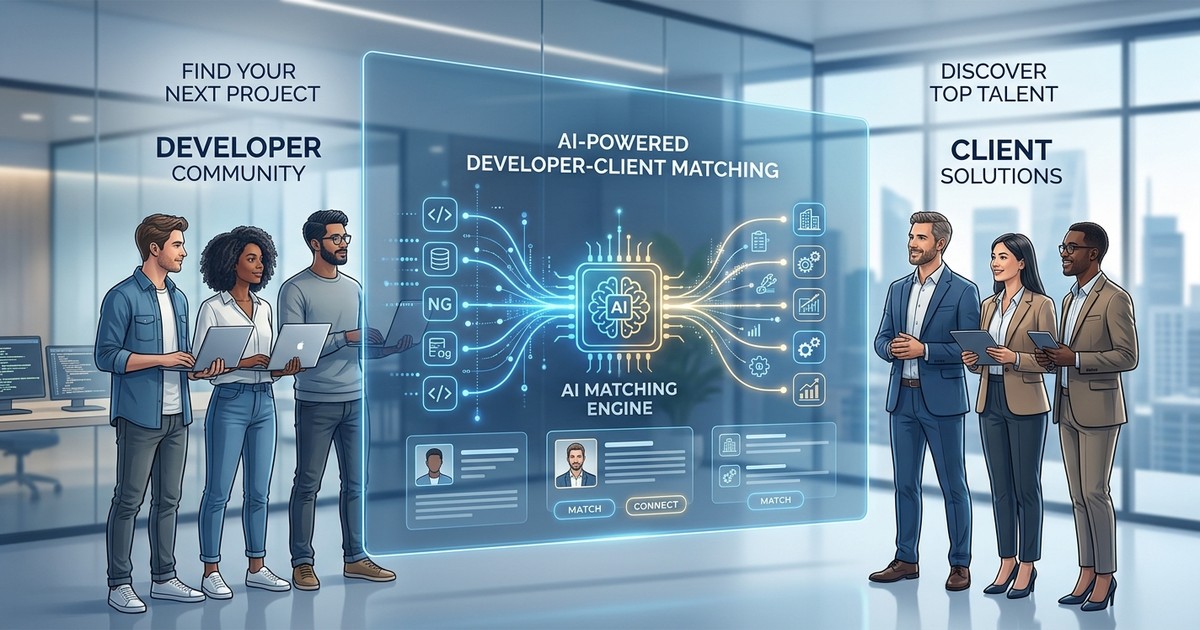
Enducer was architected from inception to leverage semantic AI for developer-client matching. While legacy platforms remain anchored to keyword-heavy profiles and rigid categorization taxonomies, Enducer deploys multidimensional semantic analysis to align technical projects with appropriately skilled talent.
Project Context Comprehension: Rather than matching based on technology lists alone, Enducer's AI evaluates what candidates have actually constructed—the complexity domains, architectural decisions, problem categories, and delivery contexts of their prior work. This contextual understanding enables matching that transcends superficial keyword overlap.
Skill Cluster Intelligence: Enducer maps competency relationships that keyword systems ignore. Node.js expertise typically correlates with Express framework proficiency, REST API design capability, and asynchronous programming patterns. Our AI recognizes these natural skill affinities, expanding relevant candidate discovery beyond literal search terms.
Career Trajectory Evaluation: The platform analyzes professional progression patterns to identify developers whose growth curves align with specific project complexity requirements. Early-career developers demonstrating rapid capability acquisition may match appropriately challenging assignments that keyword systems would filter based purely on years-of-experience metrics.
Health Score Predictive Metrics: Enducer's proprietary health scoring synthesizes completion rates, client satisfaction signals, communication patterns, and technical delivery quality into predictive indicators of project success. These data-driven metrics reveal capability and reliability that keyword-matched profiles cannot demonstrate.
Multi-Channel Integration: Enducer connects with the platforms where developers actually work and demonstrate capability—GitHub, Stack Overflow, technical blogs, and open source contributions. This multi-source intelligence provides holistic candidate understanding that keyword-dependent job board profiles cannot replicate.
The operational outcome: Enducer clients consistently report finding qualified developers approximately 3x faster than previous sourcing methodologies, while simultaneously achieving higher project success rates. Developers benefit equally—matching with projects that genuinely fit their expertise profiles rather than superficial keyword overlaps. Both parties win when semantic intelligence replaces lexical matching.
The Next Horizon: Agentic AI and Autonomous Recruitment
The frontier of AI-powered talent acquisition extends beyond semantic understanding into autonomous action. Agentic AI systems—already emerging in 2026—do not merely surface candidate recommendations awaiting human approval. These advanced systems autonomously manage outreach campaigns, schedule screening interactions, and continuously refine matching algorithms based on hiring outcome feedback.
Industry projections indicate that by 2027, 75% of enterprise hiring processes will incorporate agentic AI assessments and workflow automation. Organizations continuing to rely on keyword-based screening will face accelerating competitive disadvantage—not merely through inefficiency, but through systematic inability to discover the hidden talent that semantic systems reveal.
Conclusion: Intelligence, Not Just Automation
The talent matching market is projected to expand from $23.44 billion (2023) to $36.28 billion by 2033. Yet market size tells only part of the story. The decisive competitive factor is intelligence—specifically, the semantic intelligence to understand people as dynamic capability systems rather than static keyword collections.
Enducer does not merely observe this transformation—we are constructing the technical infrastructure through which developer talent will be discovered, evaluated, and matched for the coming decade. The question facing every organization is no longer whether to adopt AI-powered semantic matching, but whether to lead this transition or follow competitors who recognized its inevitability sooner.
The infrastructure for next-generation technical talent matching exists today. The decision to deploy it is yours.
Ready to experience semantic matching? Start your Enducer project today.